Friday, December 27, 2024

“Final” Acoustic Mess at Maui Sugar Mill Saloon, 12-26-24

Pat Todd and Loren Molinare
Last Saturday, at a special concert put on by Dave Gleason & The Californio Trio in Duarte, I ran into Dave Porter and Natalie Fratino of The Smokey Lonesome, and they mentioned they’d be doing a few songs the day after Christmas at the Maui Sugar Mill Saloon. I had reviewed their recent EP, but hadn’t yet had a chance to see them perform, and when I took a glance at what I thought was the full lineup of artists playing at the show, I was even more enthusiastic about attending. The show was listed as the final concert in the Acoustic Mess series, but it turned out that it was the final one put on by Gabriel John, but not the last in the series. The series will continue under new leadership next year. Still, last night’s show held the promise of being something special.

Carla Olson
According to the notice online, the show had a 7 p.m. start time, but it turns out that wasn’t quite accurate. Still, that gave me time to settle in with an IPA. I forgot the name almost immediately, except that it was a little long and the word “werewolf” was part of it. It was not hairy, but it did have a bit of a bite. As folks came in and began to fill up the place, there was an excitement in the air. Musicians and audience members alike seemed to be in high spirits. Sure, perhaps part of it was carrying over from the holiday, but part of it was the growing mass of guitar cases in the room. All those guitars were ready, and eager, to make some noise, to create a little joy, and to unite us in the process. I went back to the bar to order another werewolf, but the regular bartender had taken over and he gave me a funny look. I ended up with something called Beaver, I think, a hazy IPA. But it was good too.

Kevin Keller
At 7:38 p.m., Gabriel took the stage to announce that this marked the end of a two-year stint for him, hosting this music series at the Maui Sugar Mill Saloon. “We’re talking about the greatest bar on Earth,” he said. He then amended that statement slightly: “Not Earth, but Tarzana.” He then introduced the first artist of the night, Kevin Keller, who performed solo acoustic. “It’s the beginning of the end” was the first line sung last night, which seemed just exactly right. “This next one isn’t mine, but I get a lot of requests for it,” Kevin said in introducing “Shenandoah.” He joked that he wished people would request his songs. But my favorite was his next song, which featured a particularly passionate vocal performance. Gabriel then joined him for a cover of a rather sweet, slow rendition of Cheap Trick’s “Surrender.” It was perhaps a bit messy, leading Gabriel to say, “And that’s why I call it the Acoustic Mess.”

Gabriel John
Gabriel has a band called Slamdinistas, and Michael Gavigan, guitarist in that band, joined him for a couple of songs, including “Roll On Babe,” a Ronnie Lane song. Then Loren Molinare, also a member of Slamdinistas, but whom you probably know from The Dogs, took the stage. “I thought this would be one hell of a special night,” he said. Well, he wasn’t wrong, and he was part of what made it a special night, opening his short set with a solo acoustic rendition of The Dogs’ “Nothing Lasts 4 Ever.” “This one goes back a few moons,” he said in introducing “Rainy Wednesday,” a song that got the crowd singing along. Then Pat Todd joined him on vocals and harmonica for “I Want To Live Before I Die,” a song that came about from a conversation the two had. “I want to live before I die/It’s all gone in the blink of an eye.” Loren is also in a band called Gilt Lily, and fellow band members Paul Ill on bass, Danny Isaacs on guitar and Jody Hamilton on vocals joined him for the last song of his set, “What About You.” Some feedback and forgotten lyrics didn’t really detract from the crowd’s enjoyment of the song.

Loren Molinare

Pat Todd
Pat Todd was up next, playing acoustic guitar and harmonica. As he did a quick soundcheck, he asked the crowd, “Is that good and loud? Is it obnoxiously loud?” He added, “That’s what I want it to be.” He then opened his set with “West Of Your Last Chance,” which he dedicated to Townes Van Zandt. I love when I get the chance to see Pat Todd rocking the acoustic guitar. His set was one of the highlights of the night. He followed “West Of Your Last Chance” with “Where Is She Now” and then “Here And Gone Again,” wrapping it up with “The Ambulance Is Here,” a particularly striking song. “The ambulance is here/The undertaker’s sure to follow.” Gary Twinn followed, with Javier joining him on percussion. Apparently, they had just met while some of the other artists were performing. Yeah, the night had that sort of delicious looseness to it, which often leads to a certain magic happening. And his set was a lot of fun. Gabriel John and Michael Gavigan joined him on his last song, a cover of “Debris,” written by Ronnie Lane.

Gary Twinn

Carla Olson and Todd Wolfe
Carla Olson and Todd Wolfe then took the stage. Yeah, the show was just getting better and better. Gabriel expressed some surprise that Carla Olson was willing to do this particular music series, and it seemed that everyone in the crowd knew this was something special indeed. The duo opened with “Long Road Back,” which was the title track to the Todd Wolfe Band’s 2015 album. They followed that with “Burn For You,” a cool bluesy number. Carla told the crowd they were going to rock it up a little, and she and Todd went into “Shackles & Chains,” a song that was included on Carla Olson’s Have Harmony, Will Travel 2. That song featured some excellent guitar work from Todd Wolfe. They wrapped up the set with a really nice rendition of The Beatles’ “Two Of Us.” What a treat this was, and I wish they’d been able to play a little longer. But then Johnny Angel (also known as Johnny Angel Wendell) was up. Gabriel introduced him as “My favorite Bostonian.” I had talked with him briefly a bit earlier in the evening after he noticed my Red Sox cap. He opened his set with a song about not wanting to go to the DMV, but some crazy feedback stopped him. “You can turn the monitors off,” he offered. “I can hear myself.” The trouble persisted long enough that when it was finally over he decided to give up on that song and instead play “Do The Otter.” Yes, a fun (and funny) new dance. “You break a little shellfish on your chest.” This song also mentions Welcome Back, Kotter. He followed that with “Loralei,” which he introduced as a song about being in the smut capital of the world. Does the valley still hold that distinction? I’m not sure, but I enjoyed the song. He followed that with “My Lesbian Friend.” Then Gabriel joined him on vocals for a cover of “Poor Side Of Town.”

Johnny Angel

Ray Williams
You’d think that would be enough to call the night a total success, but there were still several performers on the bill. Ray Williams was up next. She’s a young singer/songwriter, someone I wasn’t familiar with, but someone I look forward to hearing more from. Her set featured some new material, including “You Don’t Mean It” and “Fantasy,” as well as “For The Night.” She wrapped up with “Pure Evil.” Dylan Thomas, who I’d seen play with Lisa Finnie in October, then took the stage with a full band. As he did a soundcheck, he asked John McDuffie, who was in the crowd but not playing last night, how the mix was. Everything was soon right, and Dylan Thomas delivered a great set that included “You Can’t Put Your Arms Around A Memory,” The Who’s “Substitute” and “Little Red Riding Hood.” Then Mike Williamson took the stage, joined by Dylan Thomas on electric guitar for the first couple of songs, including a cover of The Band’s “Ophelia.” There really was something of a party atmosphere the whole night. Mike Williamson’s set also included “Around The Block,” with Adam Levine from Lights Out Levine joining him on electric guitar. And this was an epic night indeed. At this point, the show had already been going for four hours, and featured some of the most interesting and storied musicians living in Los Angeles. Michael Gavigan joined Mike Williamson for a cover of “Leaving Louisiana In The Broad Daylight,” which had been a hit for The Oak Ridge Boys. Gabriel John jumped in partway through the song, singing along, though needing to read the lyrics on his phone.

Dylan Thomas

Mike Williamson

Roger Romeo
Roger Romeo (from Legs Diamond) next took the stage, joined by Ray Burke on bass. Apparently at the urging of Gabriel, a drummer joined them toward the end of their first song. It was a fun set, including some original songs and then a cover of Tracy Chapman’s “Give Me One Reason.”  Then Ray Burke left the stage so that Roger and Gabriel could do a duet on “Let It Be Me,” which was a hit for The Everly Brothers. It was after their set, as I was getting a bit tired, I learned that The Smokey Lonesome (remember, that was the group that I had gone there to see) had actually left because the show was behind schedule. It was 12:17 a.m. when I learned this. So I still haven’t seen those guys perform. Lights Out Levine was up next, a group that rocked and energized the crowd. I caught the first part of the band’s set, but at 12:30 a.m., nearly five hours into the show, I had to call it a night. I’m not sure how many artists were still to come, but I needed to get to bed. Yeah, I sound old. But it was a great night nonetheless.

Lights Out Levine

Tuesday, December 24, 2024

The dB’s: “Repercussion” (2024) CD Review

This has been a great year for fans of The dB’s. All four original members (Peter Holsapple, Chris Stamey, Will Rigby and Gene Holder) reunited for some special concerts at intimate venues. And the word is there is a possibility that the Los Angeles shows at Zebulon will be released in some form or other. That would be fantastic! Also, the band’s first two albums – Stands For Decibels and Repercussion – were remastered and reissued this year, on both CD and vinyl. Stands For Decibels came out in June, and Repercussion was released in October. Each contains one bonus track. The liner notes for this new issue of Repercussion contain thoughts and recollections from all four members, as well as from Scott Litt, who produced and mixed the album. The reissue mastering was done by Bob Weston at Chicago Mastering Service.

The album opens with “Living A Lie,” a song written by Peter Holsapple. This song was one of the highlights of the show I caught last month. It’s such a good pop number, with a great energy. Its rhythm never fails to lift my spirits. And regardless of what Scott says of the horn part in the liner notes, I dig it. “And if I keep on living/The way I have been living/You will come to me and say/All has been forgiven/But I didn’t do anything wrong/I’ve just been living a lie too long, too long.” That’s followed by “We Were Happy There,” also written by Peter Holsapple. This one too has a wonderful energy, with a strong beat, but the line “It was a long, long time ago” always makes me sad, for it seems that the happiness is a thing of a distant past. What I also love is the way the repeated line “Are you happy now?” is delivered, seemingly with a bit of anger. There is always a lot going on in this band’s songs. Sure, you can just dance around to them if you wish, but if you pay closer attention, you’ll get much more out of the experience.

“Happenstance” has a rather somber opening moment before the vocals come in. This song was written by Chris Stamey. “All I ever wanted was to make you so damn happy,” he sings, and we get a sense that that goal was not met. The section I can’t help but sing along with is this: “Think for yourself/Think it through/Don’t let her live for you/Think for yourself/Think of me/Think of what I’m saying.” And I dig that bass line. Chris Stamey also wrote “From A Window To A Screen,” a song that features some excellent vocal work. “I will tell you everything/Where do I begin/Some would say we were friends/I won’t make that mistake again/I won’t make that mistake again.” There is a pretty, yet haunted feel to this song which makes it rather compelling. I love that guitar part toward the end.

“Amplifier” is so much damn fun, a delicious song to dance to, and suddenly you realize you’re dancing to a song about suicide. Not that that stops you. It most certainly does not. In fact, you just dance with more abandon. That bass line demands it. The beat demands it. “Danny went home and killed himself last night/She’d taken everything, she’d taken everything/She took his car, she took his bike/She took everything she thought he liked/And what she couldn’t take, she found a way to break/But she left his amplifier.” And check out that cool stuff on keys just before the end. Peter Holsapple wrote this one. Then “Ask For Jill” has an even cooler beat, making it an immediate favorite. Isn’t this what pop music should be? And again, there are some interesting moments and tangents. Near the end, we hear one side of a phone conversation: “Hey, it’s Chris…what’s up…so I heard…well, look, let’s not beat around the bush…Really?... yeah, I’ll hold.” This one was written by Chris Stamey, and it was with that song that the first side of the original album concluded. By the way, all the songs so far were ones they performed at the Los Angeles concert I attended.

“I Feel Good (Today)” has an interesting opening, announcing it as some kind of psychedelic bluesy folk song. So, yeah, I’m on board right away. “It felt bad to try to pretend/I feel good, good again.” And it goes in some unexpected directions, particularly during that instrumental section in the second half. It is driving us toward some strange destination, and I will take that ride every time. Chris Stamey wrote this one. It’s followed by “Storm Warning,” written by Peter Holsapple. Check out these lyrics: “All your life, you’ve been a loser all your life/Loser all your life/Hope for the best, expect the worst/If this is heaven, you’re the first/If this is hell, you’re well-rehearsed/Be nice for a while.” And that guitar work takes us out of our normal realm. There is even some odd whistling near the end (Peter offers some thoughts on that in the liner notes).

There is something catchy about “Ups And Downs,” partly in its rhythm, but also in the rhythm of the vocal line. “You pull the strings/I dance, I sing/Or anything/Ups and downs.” That’s followed by “In Spain,” which also has a delicious groove. And I love the way the guitar dances on top of that groove. This is a song you just want to throw yourself into, cut loose to, and, as usual, the lyrics might come as a surprise, considering the great groove. “Here come those tears again/I know what could have been cannot be/I know it can’t be you and me.” Both “Ups And Downs” and “In Spain” were written by Chris Stamey.

They then slow things down a bit with “Nothing Is Wrong,” written by Peter Holsapple, this song featuring some beautiful vocal work. There is a dreamlike quality to the delivery. “I see love/As something that/Either works or it doesn’t/It’s as simple as that/Nothing I say could be wrong/What will you do with me gone/I’m just thinking about you.” The original album then concludes with “Neverland,” which opens with the line, “You’re asking where did my love go.” The energy is high again with this track, another one to dance to. “You’re asking what will I do now/What does it matter anyhow/I gave her everything I had/Everything I bought/Everything I got/The one thing I forgot/The one thing I forgot.” Peter Holsapple wrote this one. The disc’s bonus track is “pH Factor,” a seriously cool instrumental track that was included as the flip side to the “Neverland” single. It was written by Peter Holsapple, and mixes in some country and surf elements, and even includes some hand claps at one point. This tune was also included as a bonus track on the album’s 1989 reissue from IRS Records.

CD Track List

  1. Living A Lie
  2. We Were Happy There
  3. Happenstance
  4. From A Window To A Screen
  5. Amplifier
  6. Ask For Jill
  7. I Feel Good (Today)
  8. Storm Warning
  9. Ups And Downs
  10. In Spain
  11. Nothing Is Wrong
  12. Neverland
  13. pH Factor

This special re-issue of Repercussion was released on October 18, 2024 on Propeller Sound Records.

Monday, December 23, 2024

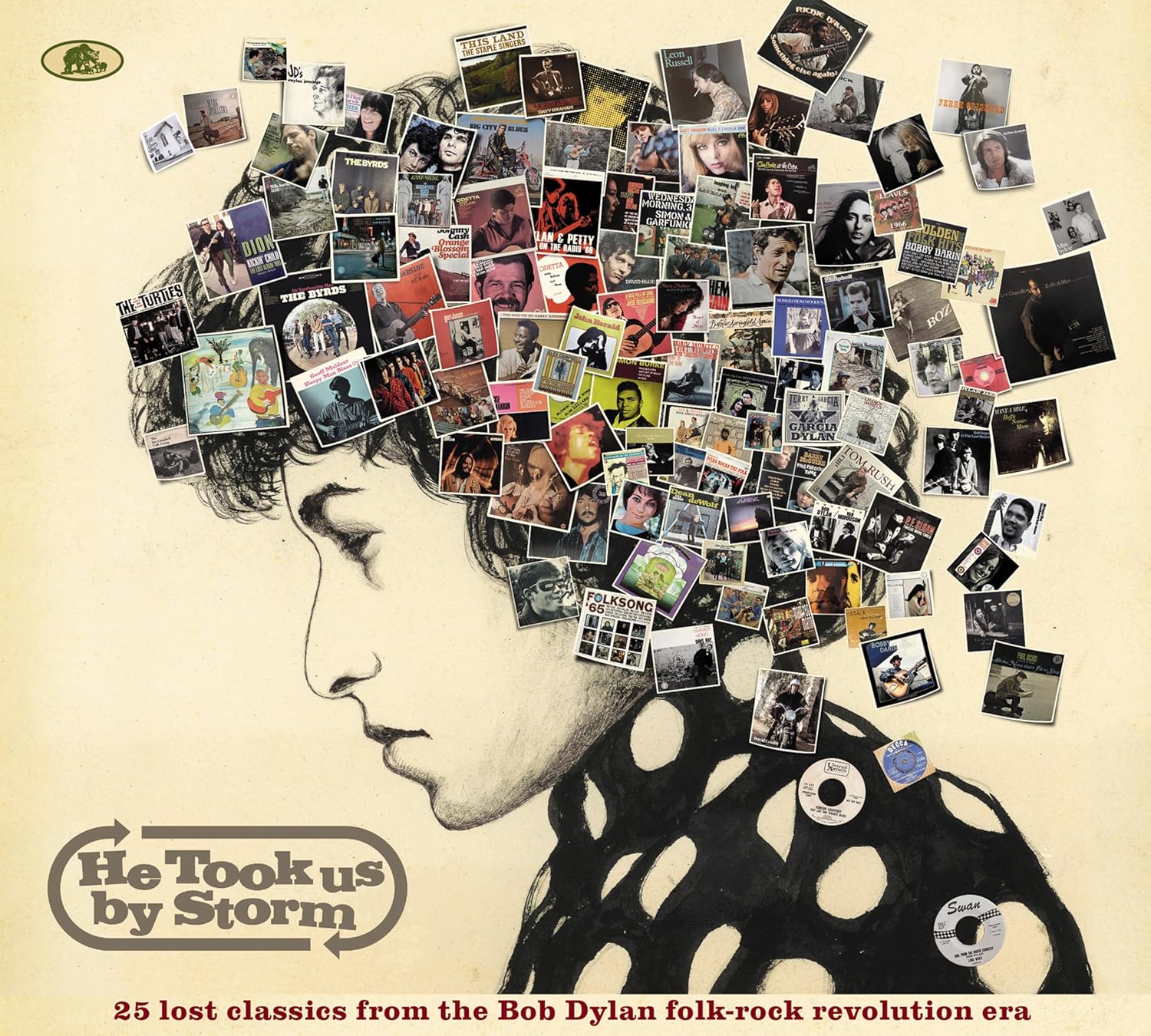
He Took Us By Storm: 25 Lost Classics From The Bob Dylan Folk-Rock Revolution Era (2024) CD Review

Bob Dylan influenced the course of music in ways that are profound and incalculable. His songs have been an important part of the soundtrack of this country for decades, and have been covered by hundreds of artists in various musical realms. He Took Us By Storm: 25 Lost Classics From The Bob Dylan Folk-Rock Revolution Era is an interesting and unusual compilation of music. It is inspired by Bob Dylan, and yet there are no actual Bob Dylan songs on this disc. But there are plenty of talented musicians, most of whom you likely know, that were inspired in one way or another by what Dylan was doing. And what’s also interesting is that the artists here are Dylan’s contemporaries, folks that were emerging around the same time or just a bit after Dylan began making his mark (with a couple of notable exceptions). Artists featured on this excellent collection include David Crosby, Lou Reed, Tom Rush, Barry McGuire, Donovan and Leon Russell. Most of the tracks were recorded in the 1960s, an exciting and fruitful time for music, and there are also several from the 1970s. Adding to the already-great appeal of this collection is a 48-page liner notes booklet, with thoughts from folks like John Sinclair, Elliott Murphy and Iggy Pop, along with notes on each of the songs chosen for inclusion.

The collection begins with a track that was recorded in 1965, but not released until 1991, Dion’s “Two Ton Feather.” Yes, that’s right, Dion of “Runaround Sue” and “The Wanderer” fame. Here he is doing a very cool bluesy folk-rock number, featuring some cool work on guitar. Dylan influence? Absolutely! You can hear it not only in the vocal approach, but in the work on piano. That’s Al Kooper on piano, so that makes perfect sense. How was it that this song was kept in the vault for decades? Insane. That’s followed by Eric Andersen’s “Honey,” and the Dylan influence is obvious in every glorious note. This song was included on More Hits From Tin Can Alley, released in 1968, one of the best years for music. And, hey, Al Kooper plays on this track too, this time on guitar. The Dylan influence is somehow even more apparent on Dick Campbell’s “You’ve Got To Be Kidding,” a track from Sings Where It’s At, from 1965. This is one of the collection’s tracks that I wasn’t familiar with, but I’m digging it. “You say that I won’t ever make it on my own/And what I know could fill an ice cream cone.”

Bobby Darin is another artist, like Dion, who already had a successful career before Bob Dylan came along, with hits like “Splish Splash” and “Dream Lover.” Well, “Me & Mr. Hohner,” the song in this collection, shows quite a different side of this talented artist. He even delivers some nice stuff on harmonica on this one. It was the lead track on his 1969 record Commitment. That’s followed by “Halloween Mary” from P.F. Sloan. Sloan is known mainly as a songwriter, having written or co-written songs like “Eve Of Destruction,” “Secret Agent Man” and “You Baby,” among others. But he put out several albums of his own too, including 1966’s Twelve More Times, from which “Halloween Mary” comes. This is a fun song, and features John Phillips on guitar and Hal Blaine on drums. “You know you’re always right/Everyone else is wrong/Your subjects, they pray to you/Three times a day to you/They’re building your shrine/On Sunset and Vine.” We then are treated to “Long Black Cadillac,” from Jackie Washington, who included it on his 1967 LP Morning Song. It’s wild how strongly Dylan’s influence is felt in songs like this one. I suppose it’s something we’ve always known, but hearing that influence in artist after artist in this collection is really something.

I recently read Bob Dylan’s Chronicles Volume One, and in that book he mentions singer and songwriter Len Chandler (that is also mentioned in this release’s liner notes). This collection includes his “Feet First Baby,” from his 1966 album To Be A Man. The Dylan influence is heard especially in the guitar work. This is one of the collection’s best tracks, in part because of Len Chandler’s passionate vocal performance. That’s followed by an artist who achieved fame covering Bob Dylan songs in The Byrds before then joining forces with Stephen Stills and Graham Nash. What we get here is a very cool early track from David Crosby, his rendition of “Willie Jean,” which was recorded in 1964. It features an absolutely wonderful vocal performance, which, I suppose, should come as no surprise. That’s followed by another demo, this one by Lou Reed, recorded in May of 1965. The song is “Men Of Good Fortune,” written by Reed. A very different rendition of this song would be included on Berlin in 1973. It’s wild hearing him firmly in the folk realm before he would take his music in a different direction. Lou Reed plays guitar and harmonica on this track.

“Little Girl” is a song from Casey Anderson’s Blues Is A Woman Gone album, released in 1965. It’s such a cool track, combining elements of blues, pop, folk and jazz. Bob Bushnell is on bass, and Panama Francis is on drums. That is followed by Bubba Fowler’s “Next Year This Time.” Bubba Fowler was a member of The Avant-Garde, and also played on records by Bob Dylan and Leonard Cohen (anyone who has played with Leonard Cohen is golden in my book). And in 1970, he put out his own LP, And Then Came Bubba, which included “Next Year This Time.” He is clearly having a great time on this track, for there is a playful element to his delivery. There is also some strong work on guitar. Then we get Dean DeWolf’s rendition of “Pistol Slapper Blues” from his 1963 album Folk Swinger.  While a lot of this collection’s tracks are heavily influenced by Dylan going electric, this song predates that style and sound. But there is interestingly something of the folk-rock sound, particularly in his vocal delivery. This is an artist I wasn’t really aware of, but now want to hear more from.

“The Gasman Won’t Buy Your Love” is the lead track from David Blue’s self-titled 1966 album, and the Dylan influence is obvious, particularly in David’s vocal performance. “They charge you for what should be free/Oh, there is so much, there’s so much that you need/Oh, to believe.” This is a lively number, particularly that work on keys. That’s followed by Tom Rush’s rendition of “You Can’t Tell A Book By The Cover,” which certainly has a Dylan feel. This song comes from his Take A Little Walk With Me album, released in 1966, an album with a sound that is different from his earlier folk releases. And, hey, Al Kooper plays on this track too. Then we get a song from Barry McGuire, “Don’t You Wonder Where It’s At,” which he wrote with P.F. Sloan (remember, Sloan wrote McGuire’s big hit, “Eve Of Destruction”). This song comes from McGuire’s 1965 release This Precious Time, and it features John Phillips on guitar and Hal Blaine on drums. “Yeah, they try to put me in a class/Change my face to fit their mask/Why do they make life such a task.”

Bob Seger released some seriously great music early in his career, as is evident by the track chosen here, “Persecution Smith,” released as a single by Bob Seger & The Last Heard in 1967. And, yeah, here Bob Seger is doing his best Bob Dylan thing. “He rises every morning, but he don’t look at the sun/He reaches in the corner, where he keeps his loaded gun/And he checks the firing action as he straps it to his chest/Plans an ambush for the mailman, even though it’s all in jest.” And the track moves at a fast clip. That’s followed by Ferré Grignard’s rendition of “Drunken Sailor,” and while not a slow track, it is probably the slowest version of this song I’ve heard. It has quite a different vibe from most of the renditions I grew up with, and definitely has something of Bob Dylan in it. Ferré Grignard released this song in 1966, including it on his self-titled debut LP. Then we go back to the early 1960s with Peter LaFarge’s rendition of “Easy Rider,” released in 1962. You’ll recognize this song as a variation of “C.C. Rider,” or “See See Rider,” and some lines from it also found their way into “I Know You Rider.” It’s a cool bluesy number.

I am a big fan of Donovan’s work (I was thrilled to meet him once at Tower Records on Sunset), and this collection includes his excellent rendition of “Universal Soldier,” a song written by Buffy Sainte-Marie. Early in his career, Donovan was referred to as the new Dylan. And you might recall that moment in Don’t Look Back where Dylan and Donovan meet. Anyway, this song was a hit for Donovan, and I not sure it would count as a “lost classic.” It’s followed by Boz Scaggs doing a great rendition of “Baby Let Me Follow You Down,” which was included on Boz, released in 1966. Here he delivers some wonderful stuff on harmonica, and, yup, he sounds a bit like Dylan. It’s so good to hear this early folk music from him. Then we get “These Are Not My People” by Billy Joe Royal. This song was included on the same record as “Hush,” which was a hit for him, and later for Deep Purple. This one is more in the folk-rock realm. “But you’re flying too high for me/And if this is how it’s got to be/Then it’s time to say you go your way and I’ll go mine/It’s been a gas, but I’m going to have to pass/These are not my people.”

I don’t know what needs to be said about Leon Russell at this point. I mean, the guy was incredible. I’m lucky to have had the chance to meet him just six months before he died, and he put on a great show that day. The song included here, “Everybody’s Talking About The Young,” comes from early in his career. It was released as a single in 1965, a full five years before his first solo album. It’s an anti-war folk-rock song, in which he asks, “Who’s going to bury all our young?” That’s followed by “Birds Can’t Row Boats,” a song that Johnny Winter released as a single in 1966 and then included on his First Winter LP in 1969. It has a Byrds vibe, with a bit of a psychedelic feel. Then we get a lively, hopping rendition of “Black Betty” by Dino Valenti, a song that was originally included on the 1970 compilation Early L.A. This collection concludes with its most recent recording, Sammy Walker’s rendition of Woody Guthrie’s “Vigilante Man” from 1979. Bob Dylan was inspired early on by Woody Guthrie, and this version takes at least some of its inspiration from Bob Dylan. It’s a good way to wrap things up.

CD Track List

  1. Two Ton Feather – Dion
  2. Honey – Eric Andersen
  3. You’ve Got To Be Kidding – Dick Campbell
  4. Me & Mr. Hohner – Bobby Darin
  5. Halloween Mary – P.F. Sloan
  6. Long Black Cadillac – Jackie Washington
  7. Feet First Baby – Len Chandler
  8. Willie Jean – David Crosby
  9. Men Of Good Fortune – Lou Reed
  10. Little Girl – Casey Anderson
  11. Next Year This Time – Bubba Fowler
  12. Pistol Slapper Blues – Dean DeWolf
  13. The Gasman Won’t Buy Your Love – David Blue
  14. You Can’t Tell A Book By The Cover – Tom Rush
  15. Don’t You Wonder Where It’s At – Barry McGuire
  16. Persecution Smith – Bob Seger & The Last Heard
  17. Drunken Sailor – Ferré Grignard
  18. Easy Rider – Peter LaFarge
  19. Universal Soldier – Donovan
  20. Baby Let Me Follow You Down – Boz Scaggs
  21. These Are Not My People – Billy Joe Royal
  22. Everybody’s Talking About The Young – Leon Russell
  23. Birds Can’t Row Boats – Johnny Winter
  24. Black Betty – Dino Valenti
  25. Vigilante Man – Sammy Walker

He Took Us By Storm: 25 Lost Classics From The Bob Dylan Folk-Rock Revolution Era was released on October 4, 2024 on Bear Family Records.